At the ACM Conference on Fairness, Accountability, and Transparency (ACM FAccT) in Athens, we formed part of the We and AI presence. This was a workshop to AI developers on how sensory boxes and objects could be used to educate AI literacy for all people, for example, learning disabled/intellectually disabled people. As part of this, we shared a handout on some pointers for the AI community for including all people in their work.
Technology promises us a huge amount. Better accessibility, greater participation, and fewer disabling barriers. Yet, many products fail to live up to this. Uninformed by lived experience, they fail to understand the real problem. At best, they are a distraction, and at worst they can be actively harmful.
Motivation, engagement, and well-being must be increased in order for tech to be helpful and serve a purpose. Self-determination posits that the fulfilment of competence, autonomy, and relatedness will motivate the self to seek optimal function and growth.
We need to link our tech usage to self-determination as a way to bring our needs front and centre. It positions psychological needs as basic motives rather than mere experiential requirements.
What do we mean by self-determination?
Autonomy Achievement of self-sufficiency and control over decisions and aspects we can control over our life. Autonomy describes “people’s universal urge to act in accord with their integrated interest and values”.
Why? This represents a strong tendency in reaction to a life of learned helplessness and constant challenges that make you feel a lack of control. Motivations may be skewed to the intrinsic-led, driven by personal enjoyment, but also tempered by extrinsic, influenced by external factors and producing demand avoidance.
Relatedness A feeling that there exist others with at least a significant extent of shared experience, which lends credibility and strength rather than always feeling different to the majority. The importance of relatedness is in forming secure emotional connections and feeling integrated into groups. Relatedness describes “the propensity to experience the sense of belongingness and connectedness to others”.
Why? It becomes essential to have access to alternatives who share common experiences when you are most regularly familiar with those who do not understand you and to whom you must always make efforts to explain or respond to mistaken assumptions.
Competence A sense of being in control and a mastery of using your skills and finding new things intuitive. The tools should land in a comfort zone that allows you to stretch yourself regularly and within reason for growth and progression, while not making you feel unable and incompetent and therefore less likely to thrive. Competence describes “people’s inherent desire to be effective in dealing with the surrounding environment”, which is the desire of feeling capable and effective.
Why? How the feeling of being a deficit because of comparing you to what the normal world expects.
Design Patterns
A core set of design patterns, which guide us to how solutions might take shape:
- Transparency - to support legibility and reduce covert workings. It refers to a sense of autonomy and our control over data. Can we trust it?
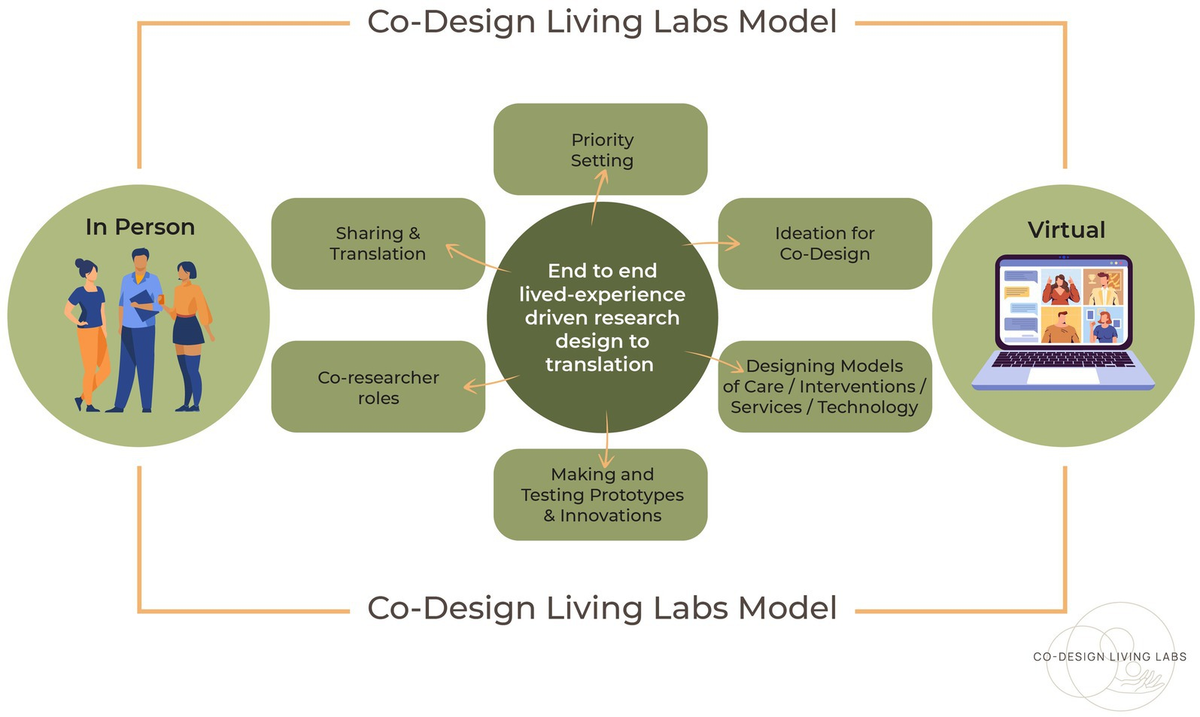
- Co-production - to include and shape a solution with a range of diverse perspectives. This can evoke relatedness, to feel engaged, motivated, and feel part of a larger team.
- Individualisation - to mould to specific needs and anticipate. Does this understand and serve me and thus lend me autonomy? Am I in control and does it suit my abilities by lowering barriers and access?
- Interoperability - so we can bring our app and data with us, and leverage existing systems holistically to serve our needs across various contexts and functions. I can assert and orchestrate my needs consistently across the expanse of my tech engagement.
- Data sovereignty to assert our ownership and control of what is ours. Providing the feeling of independence and control over myself and my data.
Resources


SDT and Autism - https://neuroclastic.com/aba-and-self-determination/
(PDF) Social Innovation Living Labs as Platforms to Co-design Social Innovations
This looks at a hybrid approach to Capability and Self-determination theories.
Phenomenological research methods from Ned Redmore at Open University:
- Simmons 2018 - The phenomenology of intersubjectivity and research with profoundly disabled children: Developing an experiential framework for analysing lived social experiences
- Simmons & Watson 2014 - The PMLD Ambiguity: Articulating the life-worlds of children with profound and multiple learning disabilities
 Dorothy Coe and Theophile Bigirumurame and Meera Burgess and John Rouse and Caroline Wroe
 Fiachra O’Brolcháin
 Fiachra O’Brolcháin
The Centre For Self Determination Theory and Technology


Zero Project's Equitable AI Knowledge Hub
 Accenture

https://www.sciencedirect.com/science/article/pii/S0262885624004529?via%3Dihub
AI Data-Driven Personalisation and Disability Inclusion
Intellectual Disability and Assistive Technology | Frontiers Research Topic
Zero Project Database | For a world with zero barriers


 Kishau Rogers
A Guide to Systems Research: Philosophy, Processes and Practice | Request PDF
 Ann BordaThe University of Melbourne

Standards:
Digital Public Goods Standard - Digital Public Goods Alliance


GitHub - DPGAlliance/dpg-resources: Resources for Digital Public Goods
 DPGAlliance
Sustainability Goals Database DPG Registry


https://www.digitalpublicgoods.net/


https://www.digitalpublicgoods.net/toolkit


Digital Impact Alliance (DIAL) https://github.com/DPGAlliance/dpg-resources?tab=readme-ov-file
 DPGAlliance
What you can do, find out more, how you can get involved, if interested, engage with us:
- GitHub community - Open access collaboration for diverse needs and cultures. Let’s make Universal Digital Public Goods. Follow us on https://codeberg.org/Digital-Diversity-Living-Lab
- Mailing list / group - Join expanding community and communication tools to build collaborations globally. info@digitaldiversitylab.org - More to come!
- Amplify - change mindsets through resonant and collective voices. Check out inclusive innovation via Amplify. Amplify: The Inclusive Innovation Collective - Diversily